White Mold of Soybean
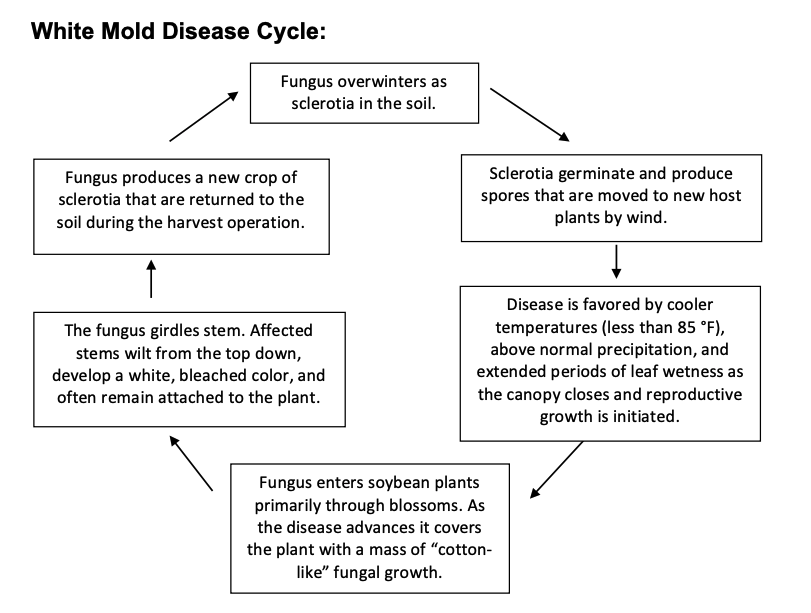
White mold of soybean (SWM) is caused by the fungus Sclerotinia sclerotiorum, and is sometimes referred to as Sclerotinia stem rot. The white mold fungus damages plants by growing in and girdling stems. This fungal growth stops flow of water and plant nutrients from the roots to the leaves, as well as the movement of sugars produced in the leaves to the developing pods. White mold causes yield loss by reducing both the number of seeds produced by the plant, and the weight of any remaining seeds that are produced. Yield loss is directly related to the percentage of plants infected by the fungus, and losses can range from three to five bushels/acre for every 10% of plants infected by the disease.
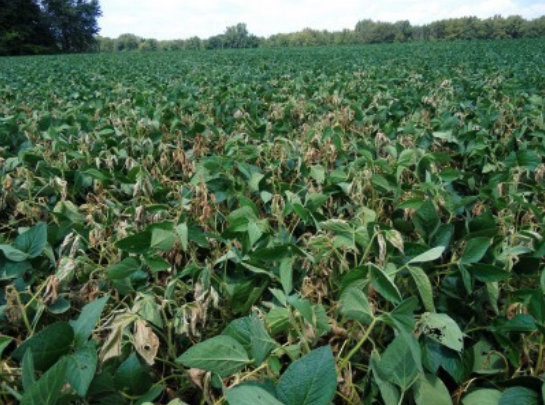
SWM most commonly establishes on plants by infecting senescing flowers, and moves from there into the plant through wounds and by direct contact between infected and healthy tissue. Once in the plant, it quickly forms stem lesions in the areas immediately adjacent to infection sites. These lesions initially appear as water-soaked areas, but develop a tan and then white, or bleached, appearance as the disease progresses. The fungus produces a white, cottony mass of fungal mycelium on infected stems, petioles, and pods, which is how it got its name “white mold.” Leaves on infected stems will begin to wilt as the fungus stops normal stem function (see Figure 1.), and pre-mature lodging of diseased stems/plants often follows. As the disease advances, the fungus produces its overwintering stage, called sclerotia, inside and on infected stems and pods (see Figure 2.). Sclerotia are hard, black, round to irregularly shaped masses.
Soybean white mold is favored by many of the same cultural practices and growing conditions commonly associated with higher yields. Here are a few of the conditions that can encourage development of SWM:
Moderate daytime high temperatures (85° F and lower)
Frequent rain events at flowering and during early pod development
Early canopy closure and/or a dense, closed canopy during flowering
Frequent rain events lead to higher SWM incidence because the causal fungus is favored by conditions that keep the canopy wet for 12 to 16 hours per day and/or continuously wet for 42 or more hours. Very high humidity, heavy dews, and fog can also encourage infection by keeping the canopy wet. Finally, early canopy closure and/or dense canopy development earlier in the growing season favor SWM for the same reason – they cause the canopy to remain wet for longer periods of time and coinciding with when the fungus is most likely to be active.
Disease Management
Cultural Practices
There are many cultural practices that can help reduce the risk of SWM. These practices should be part of an active management strategy in fields with a history of yield loss to this disease. The first set of cultural practices discourage SWM by delaying/slowing canopy closure and reducing overall canopy density, or by shifting canopy closure later into the growing season. These practices include wider row spacings (ideally 30 inches or greater), moderate plant densities (≤ 150,000 plants per acre), and later planting dates (mid-May and later). Minimizing the use of manure and/or nitrogen fertilizers in SWM prone fields is also helpful. Manure and nitrogen fertilizers promote lush plant growth and often result in earlier canopy closure.
A second set of cultural practices that help with management of SWM are aimed more at reducing the amount of causal fungus in the field, and therefore present to infect the crop. These practices include crop rotation, good weed control, and reduced tillage. The white mold fungus remains active in the soil for multiple years, and so crop rotation will be most successful if soybeans are left out of the cropping plan for a minimum of two and preferably three years. Also, to be effective, the rotation crop cannot be a host crop for Sclerotinia sclerotiorum. Non-host crops include corn and small grains; host crops include edible beans, canola, sunflowers, potatoes, cole crops (e.g. broccoli), and pulse crops (e.g. peas and lentils). Weed control is important in SWM management because many weeds commonly found in soybean fields are also hosts for the causal fungus. A partial list of weedy hosts includes lambsquarter, common ragweed, cocklebur, redroot pigweed, and velvetleaf. Avoiding tillage in fields where SWM is a problem is helpful because populations of the causal fungus have been shown to decline more rapidly in no-till conditions compared to tilled fields.
Varietal Selection
Varietal selection also plays a role in SWM management. Avoiding full season varieties, especially those with a bush architecture, lessens risk of white mold infection because fuller season, bush varieties tend to produce a larger and more dense canopy. While no variety is completely resistant to SWM, varieties do differ in their susceptibility, making varietal tolerance an important component in the disease management plan for SWM prone fields. Rob-See-Co rates varieties for tolerance to SWM using a 9 to 1 scale (9 = Best, or most tolerant). Select varieties with 7, 8, and 9 scores for fields with a history of SWM.
Chemical Control
Several fungicides are labeled for activity on SMW, but none offer complete control. Available fungicides inhibit infection by and growth of the causal fungus, and so are more effective when used as a preventative, as opposed to a curative after the disease is established. Studies have also shown that herbicides containing the active ingredient lactofen may reduce SWM by altering canopy development and/or delaying flowering.
Figure 1. Leaf wilting due to Soybean white mold. Photo courtesy of Michigan State University Extension
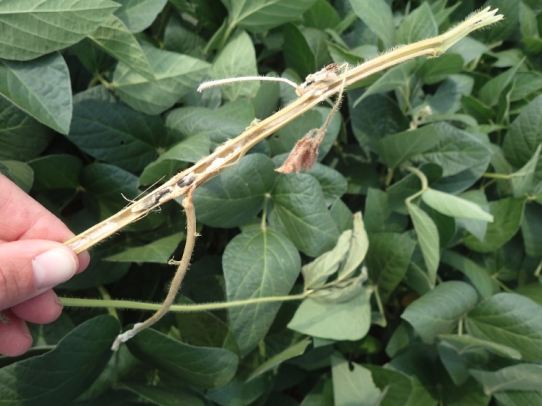
Figure 2. Sclerotia inside of a Soybean white mold infected stem