
Taking Stand Counts - Soybeans
Taking stand counts in newly emerged soybeans is important for several reasons:
Stand counts provide feedback on how well the planter did at achieving target seed drop and spacing seeds uniformly down the row.
Stand counts are the best way to see if there are problems with emergence, and, if counts are taken soon after emergence, the cause, or causes, for that problem.
Stand counts provide insight on the emergence characteristics of the variety (varieties) planted.
Finally, observations made while taking stand counts can help prioritize future management activities – timing of post emergence weed control, for example.
To begin, walk at least thirty paces straight into the field before taking a stand count. This will get you away from the field edge, where previous tire traffic and/or planter speed while slowing during turns might have altered emergence or seed drop relative to the rest of the field. Try to be random on where, and in which row, the count is started, and avoid starting counts at a spot where the stand is obviously thicker or thinner compared to average. Determine the average number of plants per foot (plants/foot) of row by counting the number of plants in three feet of an individual row. The table shows the emerged plant population in plants/acre corresponding to the number of plants/foot of row for common row widths. For example, in 30 inch rows, an average of 8 plants/foot of row (24 plants in three feet of row divided by 3 feet = 8 plants/foot of row) represents an emerged population of 140,000 plants/acre.
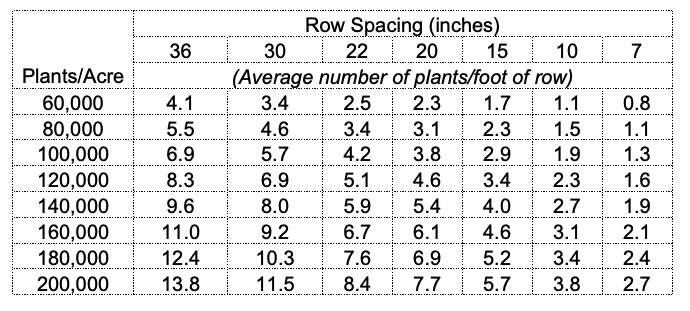
Counts involving multiple rows require very little additional time and are significantly more reliable compared to counts involving only one row. Using the same example as above but on four adjacent 30 inch rows, counts of 24, 26, 22, and 25 plants per three feet of row equals an average of 8.08 plants/foot of row (97÷4 rows = 24.25÷3 feet = 8.08) and approximately 140,000 plants/acre. In this example there is very little row to row variation, whereas counts of 24, 30, 18, and 23 (95÷4 rows = 23.75÷3 feet = 7.9) is nearly the same overall population (140,000) but indicates excessive row to row variation and a possible planter-related problem.