
Sudden Death Syndrome
The first report of Sudden death syndrome (SDS) of soybean came from Arkansas in 1971. The disease has since been confirmed throughout most states where soybeans are grown, including: Tennessee, Missouri, Mississippi (1984), Illinois, Indiana, Kentucky, Kansas (1985), Iowa (1993), Minnesota (2002), Wisconsin, Nebraska (2006), South Dakota (2012), and, most recently, Oklahoma (2014). The extent of yield loss varies depending on severity and timing of disease expression, and can exceed 50% in severe cases.
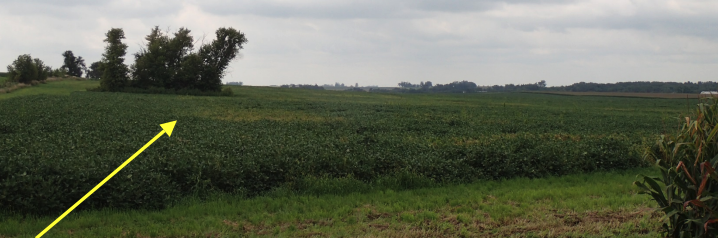
Figure 1. SDS symptoms beginning to show in a soybean field. New Hampton, IA 2016
SDS Disease Cycle
SDS begins with infection by the soil-borne fungus Fusarium virguliforme. This fungus enters seedling roots early in the growing season. Soybean seedlings are most susceptible to infection when growth is slowed by cool or wet conditions, or by compacted soils. Infection severity is also increased when soybean cyst nematode (SCN) is present in the field. Cyst nematodes damage seedling roots, stressing the plant and allowing for increased incidence and severity of Fusarium infection. Once established in the seedling root system, the causal fungus is active throughout the growing season and continues to colonize the root system as the soybean plant grows. Fusarium virguliforme overwinters in crop residue, on soil particles, and even on SCN eggs.
Above ground symptoms do not become present until mid-season, generally around the time of flowering and/or pod fill. These symptoms are caused by a toxin produced by the Fusarium. This toxin is produced in the roots and translocated to the leaves, where it causes interveinal chlorosis (leaf yellowing between the veins), and ultimately necrosis (leaf death) of the entire canopy. Splitting the stem of an SDS infected plant will reveal a white pith (center most tissue) surrounded by grey-brown cortical cells (the layer of tissue between the pith and the epidermis, or outermost layer). Splitting the stem is critical for disease confirmation, as Brown stem rot and Stem canker exhibit similar leaf symptoms, but different root and stem symptoms.
Colonization of the root system reduces the plant’s ability to provide water and nutrients to the leaves, and the interveinal chlorosis/necrosis reduces the plant’s ability to conduct photosynthesis. This reduction of nutrient and water uptake, paired with the reduction in photosynthesis, causes the plant to abort flowers and/or developing pods. Pods that are not aborted may contain fewer and smaller soybeans. Shattering losses at harvest may be increased in affected areas due to accelerated drydown from premature leaf death. Depending on timing and severity of disease expression, yield will be impacted to a variety of degrees, with earlier symptom development and more rapid leaf death resulting in greater yield loss.
Management practices to reduce your risk of yield loss from SDS
Planting date
Fields at risk for SDS should be planted later in the planting window. “At-risk” fields include: fields with a history of SDS or SCN, fields with soil compaction, and fields with poor drainage. Early planting into cool soils favors development of SDS, negating any yield benefit typically associated with earlier planting.
Variety selection
Soybean varieties vary in their tolerance to SDS. Select varieties that are characterized as having above average tolerance to SDS for “at-risk” fields. Variety tolerance combined with planting date management offers the best defense against SDS.
Tillage practices and soil conditions
Tillage is encouraged in fields that are at risk for SDS. Tillage suppresses SDS because the soil will warm and dry more quickly in a tilled field compared to a field that did not receive any tillage. Additionally, tillage practices that eliminate or prevent compaction will benefit your overall soil health by encouraging better drainage and root penetration, allowing for reduced risk of SDS infection.
Drainage management
Fields with poor drainage are at a higher risk for SDS infection, and should be scheduled for later planting.
Rotation
Rotation to an alternative crop following an SDS infection is recommended as a way to reduce the amount of inoculum in the soil. However, a one year rotation out of soybeans has not been found to significantly reduce inoculum presence, and a corn-soybean rotation has not been proven to significantly reduce the presence of Fusarium virguliforme in the soil. Findings from Iowa State researchers Shrishail S. Navi and X. B. Yang (2016) further suggest that an increased amount of inoculum survives on corn kernels as compared to corn roots. From these conclusions, it may be proposed that a field planted to soybeans after corn is at higher risk of SDS infection if there were significant harvest losses of corn grain in the field the previous fall. Cereal grains in rotation with soybeans show promise for reducing soybean disease potentials; however, research has generated mixed results.
Seed treatments
Consider the use of a seed treatment that protects seedling roots from infection. Current options include products that contain Mertect340-F from Syngenta and ILeVO from Bayer Crop Science. These products will be most effective when used in combination with additional fungicides, a nematicide, and an insecticide for broad-spectrum protection against all major early-season insects and diseases. All products are registered trademarks of their manufacturer.
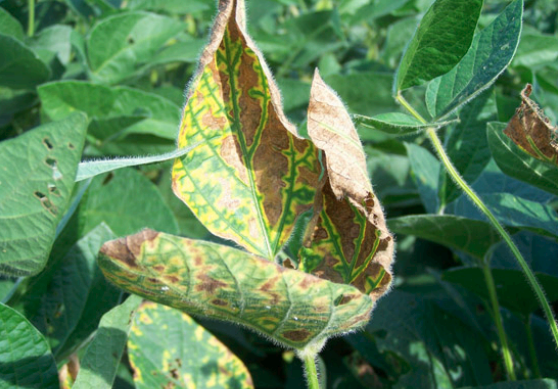
Figure 1. Interveinal chlorosis and necrosis from SDS symptoms. Photo courtesy Illinois IPM Bulletin.