
Replant Decisions - Soybeans
Sometimes fields fail to emerge at the plant population expected when the field was planted. This can happen for many different reasons, but regardless of the reason, the new questions become: “How much yield can I expect from this plant population,” and “Will I be better off if I replant this field?”
Replant decisions must be based on a comparison of the yield potential of the lower-than-desired plant population at the initial planting date to the yield potential of a full plant population at the new, later planting date. The potential yield gain must be great enough to fully offset the lost yield from the lower plant population and the cost of the replant operation, plus return a reasonable profit opportunity.
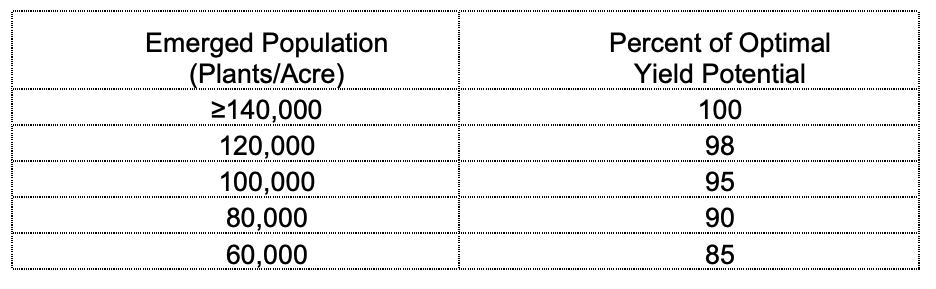
The first step of the replant decision process is to determine the yield potential of the existing stand. Research studies have shown that soybeans yield quite well over a wide range of plant populations, producing optimal to near-optimal yields at plant densities from as low as 100,000 plants per acre to as high as 200,000 plants/acre. In many studies, the yield difference between 80,000 uniformly spaced plants and a full stand of 140,000 plants is minimal. Table 1 shows the influence of emerged plant population on yield, expressed as a percent of optimal yield potential. This table can be used for all row spacings, including solid seeded, and assumes a relatively even distribution of plants and normal competition from weeds. The table also assumes an optimal planting date. If planting is delayed, a reduction factor must be applied, which is covered on in the next paragraph and in Table 2.
Table 1. Contribution of Emerged Population to Percent Yield Potential for Soybean
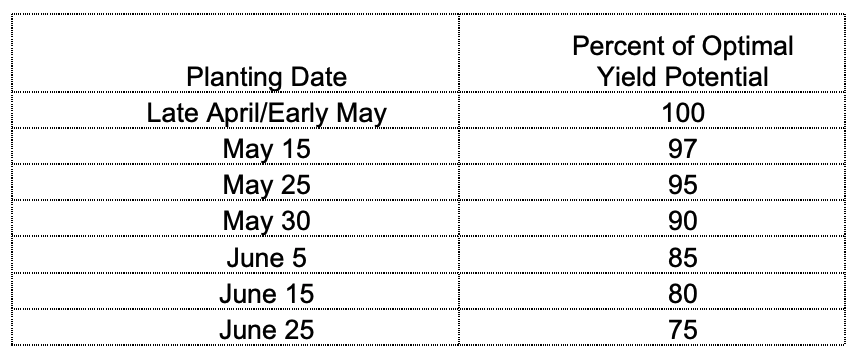
The second step of the replant decision process is to determine the yield potential of the replanted crop. Research studies have shown that soybeans are also capable of yielding well over a wide range of planting dates, producing yields that are optimal to near-optimal from late April to mid-May. Table 2 shows yield potential, expressed as a percent of optimum, by planting date. Soybeans planted at the end of May will yield 90% of optimum, for example, while soybeans planted in mid-June will only yield 80% of optimum.
Table 2. Percent of Optimal Yield Potential by Planting Date for Soybean
The final part of the replant decision process is to determine how much it will cost to actually replant the field. Replant costs vary by operation, based on size of the equipment and cost of labor. Replant costs must include the expenditures on replacement inputs, like seed, the cost to kill the existing stand, and the cost to do the re-plant operation. As an example, if the cost to replant is $60/acre and the expected grain price is $12.00/Bu, the replant must yield at least 5 Bu/acre more than the original planting in order to cover replant costs (5 Bu/acre times $12.00/Bu = $60/acre).
Using the information in Tables 1 and 2 on real-life examples:
A May 5th planted field with a yield history of 60 Bu/acre emerged at a population of 60,000 plants/acre, and now has an expected yield potential of 51 Bu/acre (85% of 60 bushels [reduced stand - see Table 1], times 100% [normal planting date - see Table 2]). A full stand replanted on June 5th would be expected to yield 51 Bu/Acre (100% of 60 bushels [full stand – see Table 1], times 85% [delayed planting - see Table 2]). Best decision: keep the lower than desired stand.
An April 30th planted field with a yield history of 80 Bu/acre emerged at a population of 60,000 plants/acre, and now has an expected yield potential of 68 Bu/acre (85% of 80 bushels [Table 1], times 100% [Table 2]). A full stand replanted on May 30th would be expected to yield 72 Bu/acre (100% of 80 bushels [Table 1], times 90% [Table 2]). At a replant cost of $60/acre and an expected grain price of $12.00/Bu, the additional 4 Bu/acre (72 minus 68) represents $48/acre, and does not exceed replant costs. Best decision: keep the lower than desired stand.
A May 10th planted field with a yield history of 50 Bu/acre emerged at an average population of 40,000 plants/acre. The stand exceeds 60,000 plants/acre in places, but there are many areas with large gaps and, in these areas, an estimated population of less than 10,000 plants/acre. A full stand replanted on June 5th would be expected to yield 42.5 Bu/acre (85% of 50 bushels). Even at a replant cost of $60/acre and an expected replant yield of 42.5 Bu/acre, the presence of large areas with low plant populations will result in significant weed problems and an expected economic loss that will exceed replant costs. Best decision: replant the field as soon as possible.
Other considerations when replanting soybeans:
The same relative maturity (RM) soybean variety will reach maturity (95% brown pods) approximately one day later for each 2.5 day delay in planting date. For example, the same Group 2.6 soybean variety planted on May 15 will reach maturity about one week later in the fall if it is planted on June 1st.
Each 0.1 change, up or down, in soybean RM will shift the maturity date by approximately 1 day. As an example, if a Group 2.8 RM variety and Group 3.0 RM variety are planted together in a field on the same day, the Group 3.0 will reach maturity about 2 days later compared to the Group 2.8 variety.
Stay with fairly full season RM varieties in more central geographies, even into late June. In more northern geographies, shift to earlier RM varieties in mid-June, and to at least a 0.5 RM Group earlier variety in late June/July.
Eliminate all plants from the initial planting. This is to prevent competition between the replanted crop and the few remaining plants from the initial planting. Early planted survivors will be significantly larger and will dramatically reduce yield of replanted plants growing in the area surrounding them. The remaining early plants will also be much farther along at the end of the season and could cause problems during harvest (shatter, standability, positioning of reel on platform heads, etc…).