
Goss’s Wilt of Corn
Disease Cycle
Goss’s wilt is caused by the bacteria Clavibacter michiganesis subsp. nebraskensis. This pathogen overwinters in infected debris from a previous crop. Goss’s wilt infects new plants/fields in three distinct ways:
Most common: The causal bacteria is dispersed into the air during a thunderstorm and carried with rain to leaves of healthy plants. Once airborne, the causal bacteria can travel in a rain cloud for several miles, but it can only enter leaves through openings in leaf tissue caused by sand-blasting, wind, and/or hail.
Less common: Bacteria enters seedling plants through the root system and causes seedling blight. Occurrence of this type of infection is limited to fields infected by Goss’s wilt the prior year.
Least common: Bacteria is seed-borne from a prior year infection of the mother plant. This mode of infection is most common in volunteer corn.
Goss’s wilt is a disease of dent, flint, sweet, and popcorn. The causal bacteria has also been isolated from naturally occurring infections of green foxtail and shattercane, and has been artificially established on grain sorghum, eastern gamagrass, and Sudan grass. Research indicates that the bacteria responsible for Goss’s wilt only survives for 10 months on infected residue located at or near the soil surface.
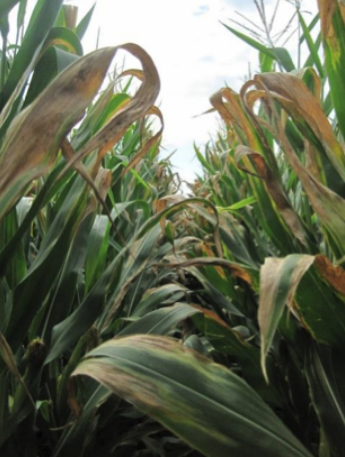
Figure 1. Corn showing leaf blight symptoms of Goss's wilt. Photo courtesy of Iowa State University
Disease Symptoms
Goss’s wilt is a systemic, vascular wilt disease. It is most easily recognized by wavy gray to light yellow lesions that follow leaf veins. These lesions can have the appearance of water-soaked margins. Dark green “freckles” often form on the edge of active lesions and serve as the best diagnostic symptom to distinguish Goss’s wilt from other diseases such as Stewart’s bacterial wilt and Northern corn leaf blight, or from leaf scorch. Lesions commonly develop a shiny film from bacterial exudate that oozes out onto the leaf surface and dries.
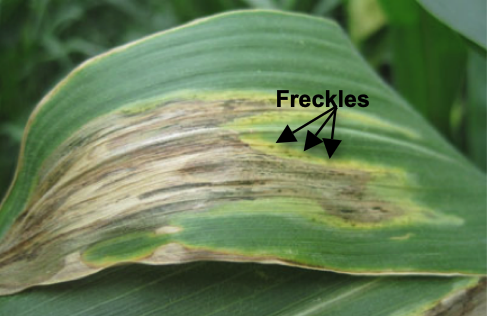
Figure 2. The yellow-gray watersoaked margins with dark green "freckles" are indicative of Goss's wilt. Photo courtesy of Iowa State University.
Goss’s wilt causes yield loss by stopping water and sugar movement in affected tissue. The amount of yield loss is dependent on several factors, including hybrid susceptibility and timing of the infection. Early infections of a susceptible hybrid are the most damaging, and severe Goss’s wilt infections can result in yield losses in excess of 50%.
There are no effective rescue measures to stop a Goss’s wilt infection once the bacteria is established in the plant. However, there are several ways to prevent or lessen damage caused by a Goss’s wilt infection.
Management of Goss’s Wilt
Crop Rotation
Rotating to a crop other than corn following a Goss’s wilt infection is the most effective method for managing the disease. (Clavibacter michiganesis subsp. nebraskensis is not able to survive a growing season without infecting a susceptible host, and therefore is not present to infect corn following the rotation crop.)
Hybrid Selection
Hybrids vary greatly in their tolerance to Goss’s wilt. A susceptible hybrid planted the year following a Goss’s wilt infection will be at risk of yield loss. Conversely, a tolerant hybrid may not lose any yield or show visible disease symptoms, even after a moderate to severe infection the prior year. Rob-See-Co rates hybrids for their tolerance to Goss’s wilt (see below).
Tillage
Burying diseased crop residue immediately after harvest is an effective method of reducing bacterial populations and disease severity in the following year’s crop. However, burying infected residue may not be compatible with good soil stewardship – especially when tolerant hybrids are available.
Rob-See-Co Ratings for Goss’s Wilt Tolerance
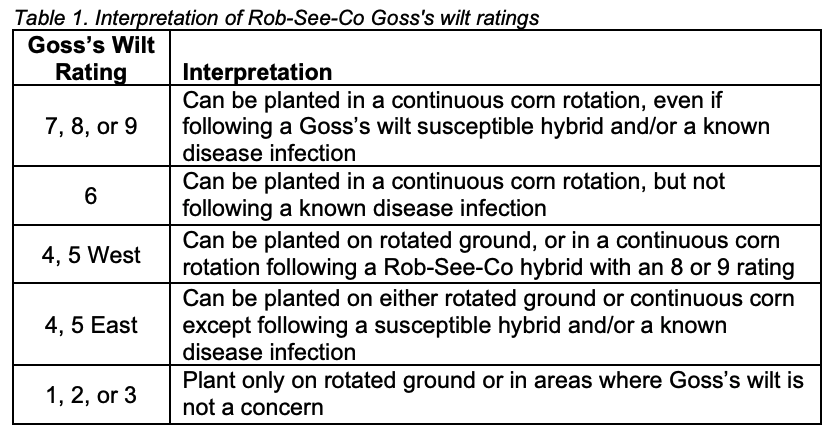
Rob-See-Co uses a 9-1 rating system (9=best; 1=worst) to rate hybrids for their tolerance to Goss’s wilt. Since Goss’s wilt is more prevalent in the west, Rob-See-Co suggests different east/west interpretations for hybrids rated a 4 or a 5. As a simple reference for east/west, Rob-See-Co considers the split to occur along a line from Minneapolis, MN south through Des Moines, IA and Kansas City, MO and extending south along the KansasMissouri state line.
Examples:
A field was planted to soybeans the prior year. Adjacent fields were soybeans and/or fall tilled corn.
Goss’s wilt is not a concern. A hybrid with any Goss’s wilt rating (9-1) may be planted.
A field was planted to soybeans last year but an adjacent field had a Goss’s wilt infection, was shredded in the fall and will not be tilled until spring (adjacent field is a source for transfer of infected residue).
A hybrid with a Goss’s wilt rating of 7, 8, or 9 should be planted.
A field was planted to soybeans last year but an adjacent field had a Goss’s Wilt infection and was chopped for silage.
A hybrid with any Goss’s wilt rating (9-1) may be planted because there will be minimal to no above ground infected residue to transfer between fields.
A field was planted to a corn hybrid with a Goss’s wilt rating of 7 last year and no infection was observed.
A hybrid with a Goss’s wilt rating of 6 or greater should be planted west of the line defined above, and a hybrid of 4 or greater should be planted east of that line.
A field was planted to a corn hybrid with a Goss’s wilt rating of 8 or 9 last year and no infection was observed.
A hybrid with a Goss’s wilt rating of 4 or greater should be planted regardless of geography.