
Ear Feeding Insects of Corn
The three most prominent insect pests causing damage to the ears of corn are the Corn earworm, the Western bean cutworm, and the European corn borer. All three are moths from the taxonomic order Lepidoptera, but the life cycle stage responsible for damage is the larval stage. Damage caused by these pests includes fewer kernels per ear and an increase in the number of partially damaged kernels in the harvested grain. In a few cases, ears of damaged plants can be deformed or stunted, and in nearly all cases, damage is accompanied by an increase in fungal ear rots and greater incidence of fungal mycotoxins. Damage to the ear shank by European corn borer larvae can also result in increased incidence of ear drop. Because these insect larvae feed directly on ears, they are protected by the husks and nearly impossible to control after they enter the ear and begin feeding. Reducing/stopping damage by these pests requires either prevention or control strategies implemented prior to larva entering the ear.
Corn Earworm
Corn earworm do not overwinter in the Central and Northern Corn Belt. Each year, a new flush of Corn earworm moths migrates from the extreme Southern United States (and areas farther south) to corn growing regions farther north. Fields in the Southern Corn Belt can experience two generations of this insect per year, with the first generation feeding in the whorl of mid- and late vegetative stage corn and the second generation feeding in the ear. Whorl feeding is rare in the Central and Northern Corn Belt, but ear feeding can be common, especially in some years.
Female moths prefer to lay their eggs directly in the mass of silks extending out of the ear tip. Eggs are laid individually, but more than one egg can be laid in the same ear tip. Larva hatch and immediately move down to feed on the developing ear tip. Corn earworm larvae are cannibalistic, so only one larva per ear will survive to maturity and pupate. Corn earworm larvae are initially a translucent to white color and have a black head. As they grow, their head will turn a dark yellow or orange and their body develops a yellow, brown, or reddish green color with prominent bands extending the length of their body on both sides. These bands can be cream, pink, green, or yellow in color. There are five, sometimes six, instar stages during larval development, and fullygrown larvae are approximately 1 5/8th inch long.
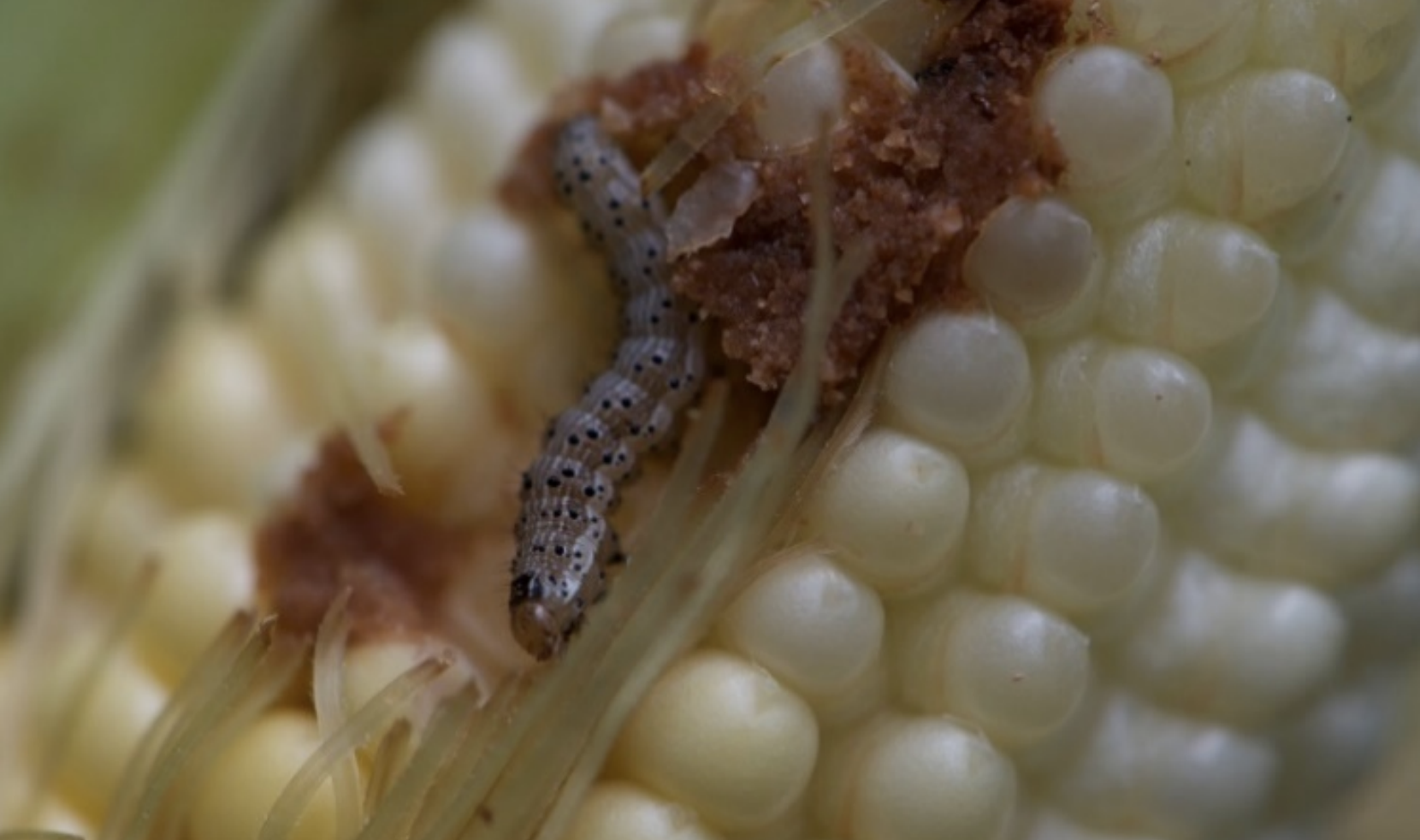
Figure 1. Corn earworm larva and feeding damage.
Many biotech traits with activity on European corn borer also provide partial control of Corn earworm larvae, and research on the Agrisure® Corn Borer trait, which is one of the most efficacious, has demonstrated approximately 50% reduction in corn earworm damage to ears when compared to the same hybrid without the trait. Agrisure Viptera® is the only transgenic trait available in the market that provides complete control of Corn earworm larvae, and Syngenta research has shown that hybrids carrying the Viptera trait return over 7 bushels more yield per acre in the presence of ear feeding Lepidopteran insects, with Corn earworm being the dominant insect pest in these studies.
Western Bean Cutworm
Western bean cutworm (WBC), as their name implies, are primarily a pest of corn in the western half of the Corn Belt and are distributed from the Rocky Mountains east to Iowa and northeast into Wisconsin. There is only one generation per year. WBC overwinter in pupal cells below the soil surface, pupating in mid-spring and emerging as adult moths in early summer. Moths prefer to lay eggs in late vegetative stage corn (V16 to V18) and will lay eggs in masses of 5 to 200 eggs, most commonly on the upper side of the uppermost leaves. Eggs are initially white, and over a five to seven-day period slowly turn a pink or pale blue color as the larvae inside mature.
Newly hatched larvae immediately migrate to the tassel, if the field has not yet tasseled, or to the ear in tasseled fields. In the case of pretassel corn, they will feed on developing pollen sacs until the leaves begin to open around the tassel, and then move down the plant to the ear. Management strategies based on an insecticide application must be made while larvae are exposed and before they enter the ear, so either during their initial migration to the ear (tasseled fields at hatch), or while they move from the tassel to the ear (pre-tassel fields at hatch).
Young larvae have pale colored bodies and brown stripes running lengthwise along their backs. As they mature they develop a light brown to pale gray body and a brown head. Immediately behind the head is a dark brown body segment resembling a collar. In this “collar” are three pale stripes that are oriented parallel to the body. Unlike Corn earworm, WBC are not cannibalistic and multiple larvae can be found feeding on the same ear. Larvae will continue to feed through the grainfill period, then move down the plant to burrow into the soil and form their earthen pupal cell, completing the annual cycle. Agrisure Viptera® trait is the only available biotech trait that fully controls WBC.
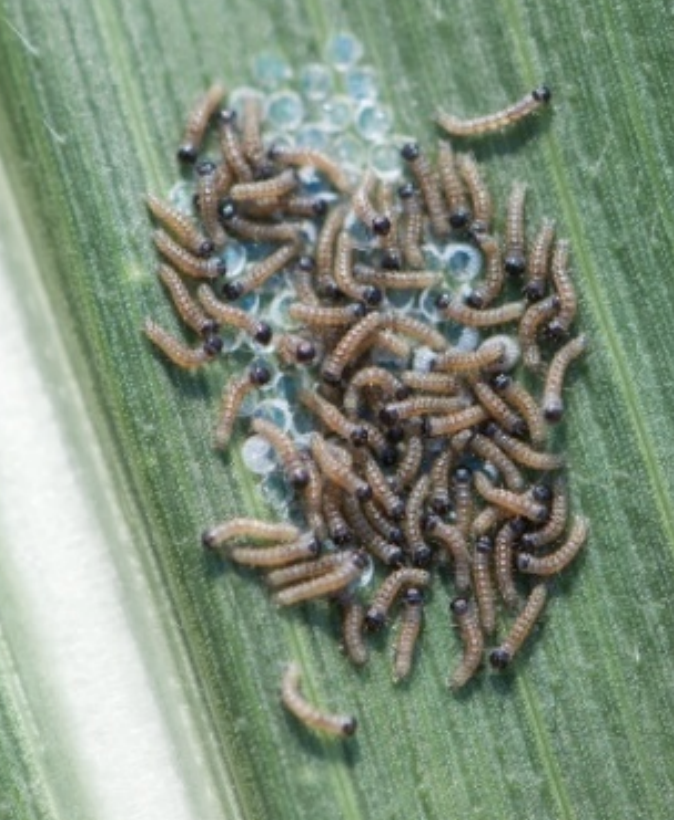
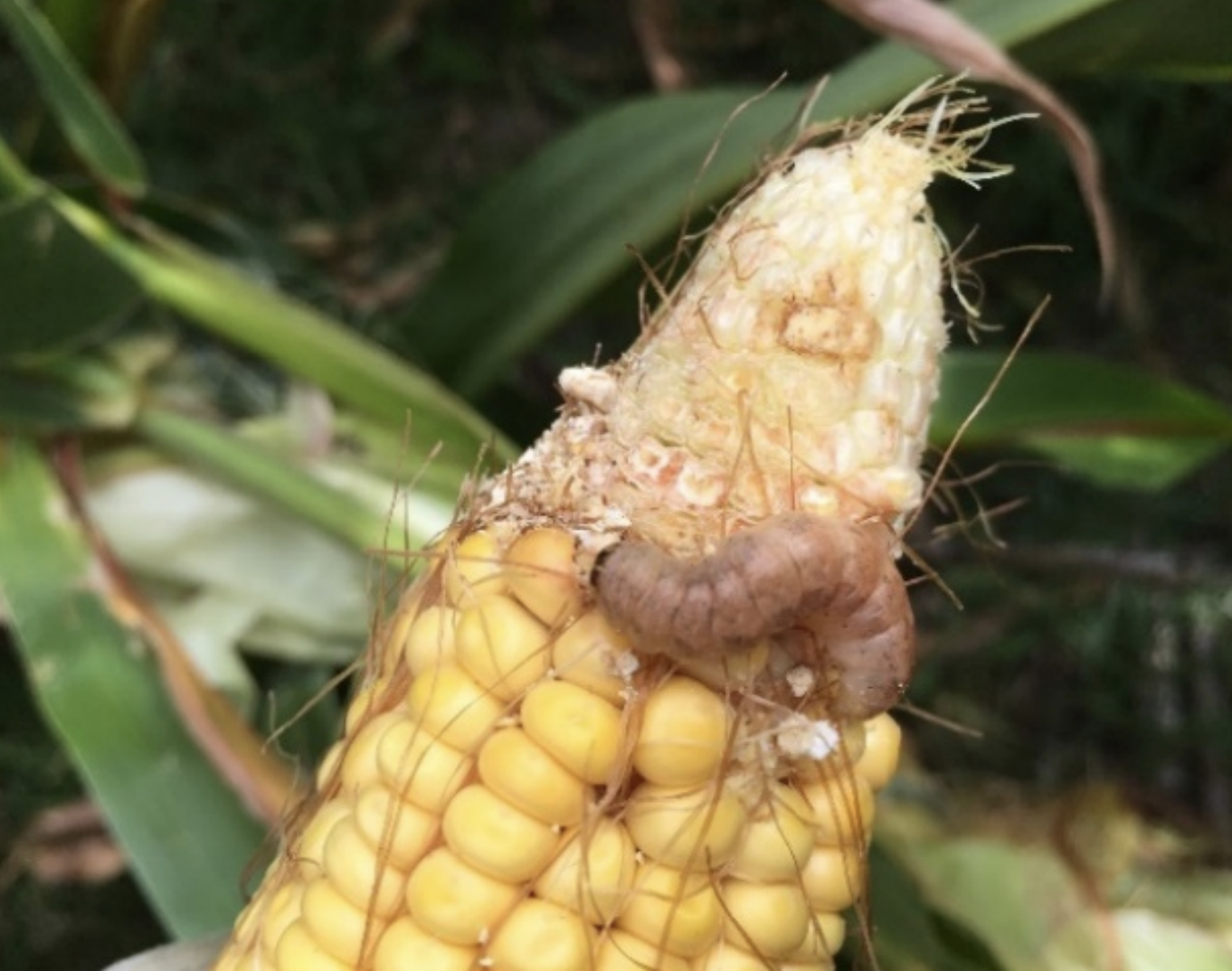
Figure 2. Newly hatched WBC egg mass.
Figure 3. WBC larva and feeding damage
European Corn Borer
European corn borer (ECB) will feed in the ear on developing kernels, down the center of the cob, and in ear shanks. Which generation of ECB, univolt, second, or third, might be found active in the ear depends on location, with the later generations most common in more central and southern geographies. Masses of creamy-white to translucent eggs are (mostly) laid on the underside of the ear leaf and adjacent leaves (+/- 2). A black spot, which is the developing larva’s head capsule, becomes apparent in the eggs as they approach hatch. Young larvae may feed on pollen in the leaf axis for a short time, but generally move fairly quickly to the developing ear. Mature larvae are ¾ to one inch in length and have a creamy white to gray body and a brown head. All available biotech corn borer traits currently provide effective control of this insect in corn growing areas of the United States. Use of trait stacks with dual modes of action for control of European corn borer are highly recommended as tools for long-term resistance management of this insect pest.
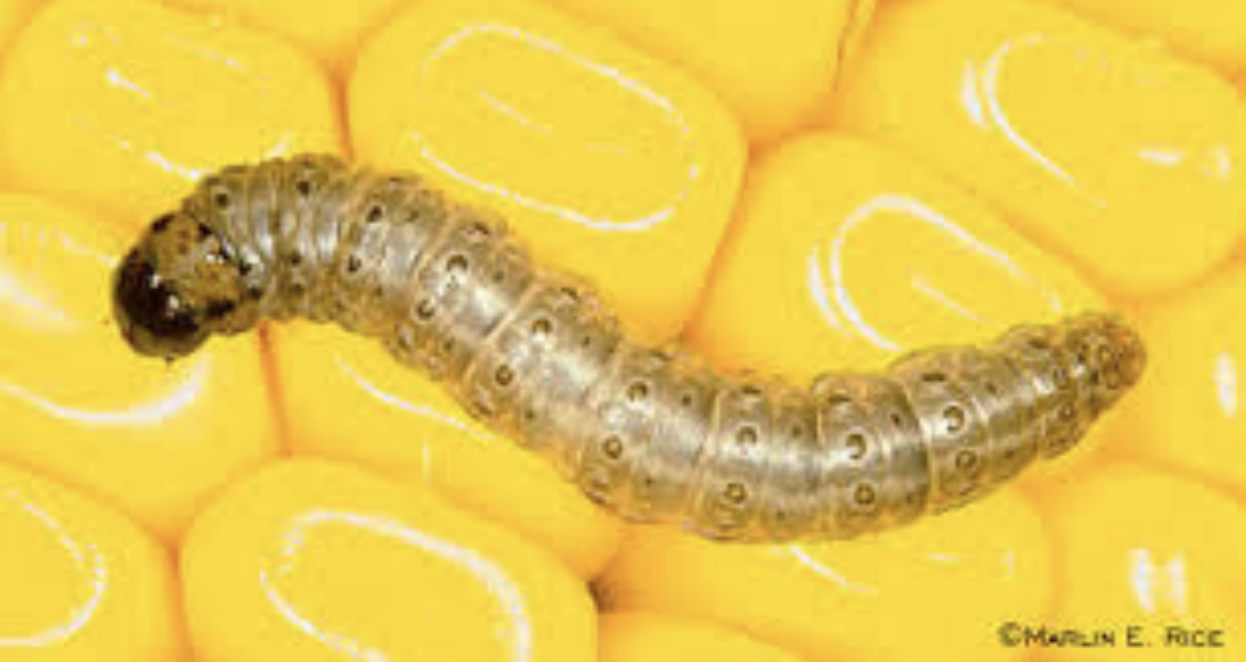
Figure 4. European corn borer larva. Photo courtesy of Iowa State University.