
Common Emergence Problems – Corn
Appearance of a Healthy Seedling Corn Plant Shortly after Emergence
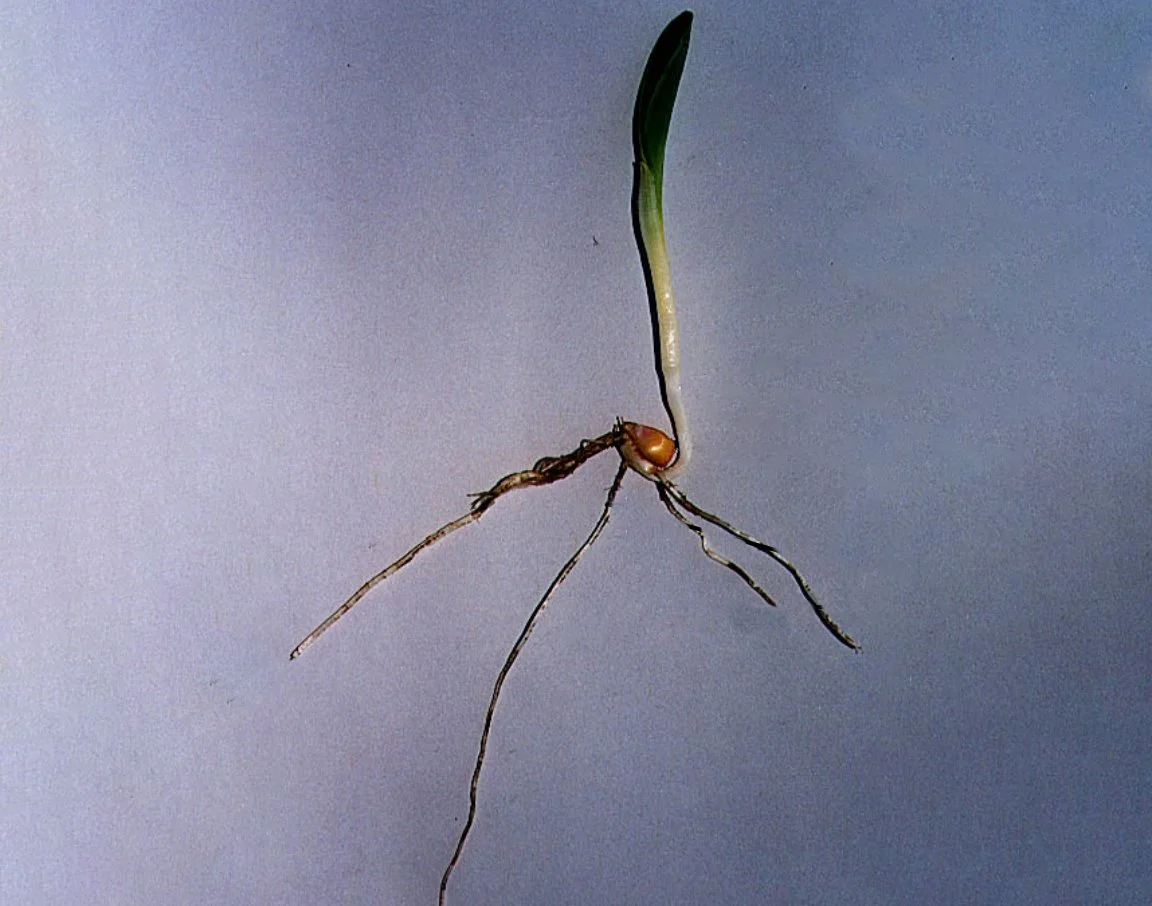
A higher than expected number of skips, or blank areas in the row where a corn plant should have been but is missing, can be an indication of an emergence problem. Plants that are in close proximity up and down the row but are at different stages of development (showing a different number of leaves) is also an indication of an emergence problem. Finally, emerged plants that simply do not have a healthy, vigorous appearance can be yet another indication of an emergence problem. Emergence problems can be caused by many different factors, and sometimes are even the result of more than one factor acting at the same time.
The first step in understanding emergence problems is to contrast the symptoms being observed with what a healthy corn plant would look like at that same stage of development.
Leaf shape, size and color appear normal
Spike is straight, firm, and has a white to light yellow color
Location of growing point at emergence
Mesocotyl is white and firm to the touch
Seed is firm, shape and color appear normal
Seedling roots show normal side branching and overall length
Because the cause of emergence problems is more often found below the soil line, as opposed to above it, the best way to investigate the problem is to literally “do some digging.” The rest of this Agronomy Tips sheet connects symptoms with the cause of more frequently observed emergence problems in corn.
Cause and Symptoms of More Common Emergence Problems in Corn
Fertilizer burn: Seed has a carmel-brown to black color. Roots are shortened or nearly completely missing, and root tips are blackened and brittle
Seedling disease/damping-off: Seed is brown, wet and squishy, mesocotyl and roots are watery, have a brownish color, and are soft (Pythum, Fusarium)
Seedling disease: Mesocotyl and/or spike has a dry, light brown to reddish discoloration or dry rot (Rhyzoctonia)
Molded kernels: Seed is covered with a fuzzy, white to blue-green mold (Penecillium)
Planted too shallow: Mesocotyl region is missing or very short (less than ½ inch in length)
Planted too deep: Mesocotyl region exceeds 1½ inches in length, sprout is bent and/or has unfurled (leaves have opened) before it reached the soil surface
Insect damage: Seed has holes in it or is partly missing, mesocotyl and/or growing point has areas where tissue is missing, roots are scarred or hollowed (insect damaged tissues will develop a reddish brown discoloration and may initially resemble a dry rot appearance)
Cloddy soil surface, crusted soil surface: Sprout is bent, curled, and/or has unfurled (leaves have opened) before it reached the soil surface
Failure to fully close the seed slot: Sprout is bent, curled, and/or has unfurled (leaves have opened) before it reached the soil surface, seedling roots are abnormally long (greater than 2½ to 3 inches)
Chilling injury during or immediately following germination: Swollen kernels that failed to germinate, stunted seedling roots and/or sprout, curling or "corkscrew" growth in mesocotyl region and/or sprout
Dead seed: Otherwise normal appearing seed that failed to germinate
Weak seed: Spindly, abnormal sprout that failed to reach the soil surface, seedling roots are shortened or missing
Soil compaction: Root system shows abnormal bends or is growing at abnormal angles
Herbicide injury: Roots are swollen, many roots are fused together as one, roots are growing upward or out, not down, leaves are smaller than normal and/or discolored (yellow, brown, etc...)